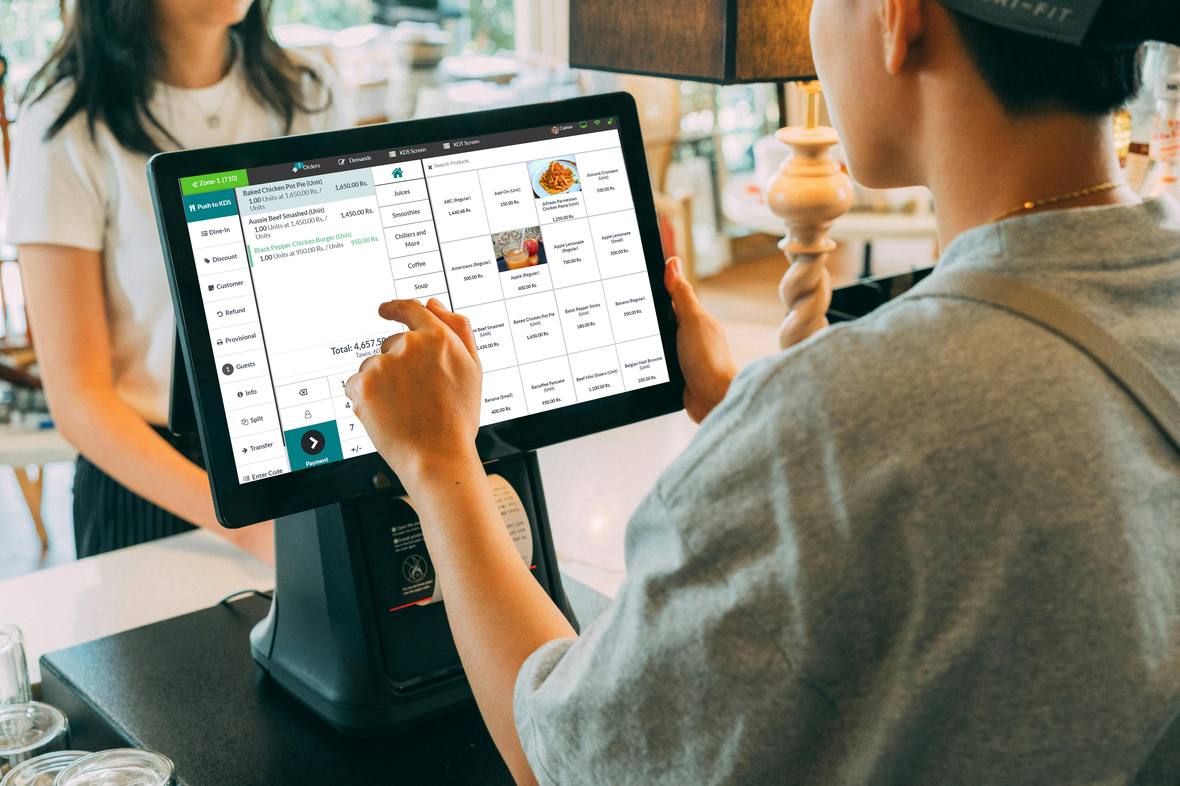
Lanes clear faster
Weighed items price themselves, packaged goods scan, and payment closes at the lane. Several terminals run against the same stock and the same sales, so adding a lane at peak does not add a reconciliation problem.
VisioEdge › VisioEdge for supermarkets & grocery
Grocery runs on turnover rather than markup, which makes two things decisive: how quickly a lane clears, and whether what the system holds matches what is on the shelf. Almost everything else is downstream of those two.

Produce and bulk items are weighed, priced by hand and keyed in while the queue builds behind them.
The gap between purchased and sold appears once a quarter, with no way to trace when or where it happened.
Selling by case to shopkeepers and by unit to walk-ins means two systems and a very manual reconciliation.
Four changes that show up directly in throughput and in shrinkage.
Weighed items price themselves, packaged goods scan, and payment closes at the lane. Several terminals run against the same stock and the same sales, so adding a lane at peak does not add a reconciliation problem.
Every movement is timestamped and attributable, and each order carries a full journey log. A discrepancy narrows to a day, a lane and a person instead of becoming a write-off nobody can explain.
The same product sells by case to a shopkeeper and by unit to a walk-in, priced accordingly, out of the same stock and into the same books.
Purchasing is driven by what is actually moving, with inventory at risk flagged early. Fresh lines stop running out on a Saturday and slow lines stop absorbing cash.
Check it against whatever you are running now.
Tell us how you operate and we will set the demo up around it, rather than showing you a sample business.
Send us your details and we'll set the demo up with your dishes, your prices and your branches — so you're judging the real thing.
* Required — everything except the last box
We'll message you on WhatsApp first. If you'd rather we called, say so in the reply and we will.